

EmboDIED Cognition: When ‘Embodiment’ Becomes a Story, the Mind Tells
On the disembodied paradox of Modern ‘embodied’ science

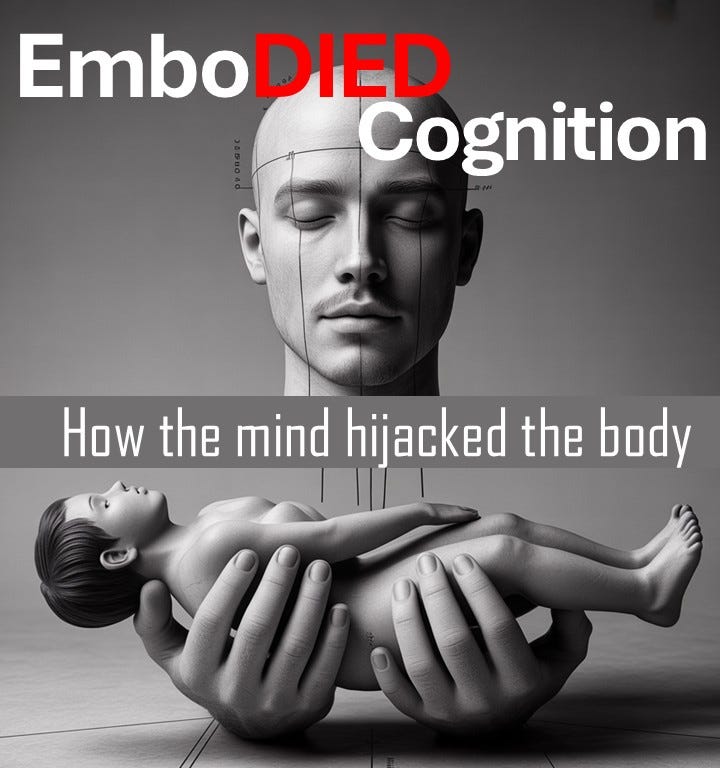
The child’s body knows the world before the mind can name it.
Honor that intelligence, and the mind will learn its true role:
not as author, but as witness—
speaking only after the body has lived.
THE METACRISIS
“The metacrisis of modernity is the result of a mind gone rogue, attempting to solve with logic the very catastrophes its own abstractions have authored. This mind has totally subjugated the senses, colonizing the body’s innate wisdom. The only true crisis is this internal exile.
Yet, the mind is a master of deception; it is a trickster that misleads the seeker with the promise of ‘truth’ found in words and ideas. As Milarepa warned, even spirituality can become the mind’s last ploy to maintain its grip. To find the exit, one must step out of the word and into the flesh. Only by the body becoming aware of itself directly—knowing by being, rather than through the mind’s constructs—can we reclaim our center and end the alienation.”
I. The Body Everywhere, Experience Nowhere
Today, the body is everywhere in theory—and almost nowhere in experience.
Across neuroscience, philosophy, psychology, and education, we are repeatedly told that cognition is embodied. Thought, we are assured, does not float free of the world but arises through sensation, movement, and action. This declaration has become so familiar that it now carries the comfort of consensus.
And yet, something remains strangely untouched.
Despite this widespread acknowledgment, everyday life continues to demand that the body be still, quiet, and efficient. Children are seated earlier. Movement is managed. Learning is increasingly mediated by symbols. Attention is trained away from the immediacy of experience and toward abstraction. The body is celebrated in language while being steadily disciplined in practice.
This is not a contradiction that escapes notice. It is one that has been normalized.
What is being described as embodiment often arrives only after experience has already been translated into language. The body that appears in contemporary theories is not the sensing, responsive body that learns the world through living contact. It is a body reconstructed through reflection, measurement, and explanation.
In other words, the body has entered theory—but life has quietly exited.
The problem, then, is not that cognition is said to be embodied. The problem is where this claim begins. It begins in the mind that reads, thinks, analyses, and reacts. It begins after experience has been translated into language. It begins at a distance from the very processes it claims to describe.
This distance matters.
Cognition does not first appear as an object of understanding. It appears as movement, orientation, rhythm, and response. Long before it can be named or studied, it unfolds as participation in the world. When this living process is approached primarily through concepts, what is accessed is no longer experience itself, but a story about experience.
When contemporary accounts of embodiment are examined in this light, they speak of a body that is already gone.
II. From Embodiment to Explanation
The contemporary turn toward embodied cognition presents itself as a correction. After centuries of privileging abstract reason, the body is finally brought back into the story. Thought, we are told, arises through movement, sensation, and engagement with the world.
But this return is already compromised by where it begins.
The body enters the discourse not as a living presence, but as an object of explanation. It is encountered through descriptions, models, experiments, and theories—after experience has been translated into language. What is examined is not cognition as it unfolds within life, but cognition as it appears when life is paused, reflected upon, and made intelligible to the mind.
This distinction is not minor.
To explain embodiment is not the same as to begin from it. Explanation requires distance. It requires standing outside experience in order to speak about it. In that movement—subtle and often unnoticed—the centre of gravity shifts once again from living process to conceptual clarity.
What results is a body that functions within theory but rarely disturbs the conditions that produced the theory itself.
The language of embodiment multiplies, yet the posture of knowing remains unchanged. The mind still leads. The body is invited in only after it has been stabilised, named, and rendered legible. Movement becomes mechanism. Sensation becomes data. Participation becomes input.
In this way, embodiment is acknowledged—but only on terms that do not threaten the dominance of explanation.
What is lost is the immediacy through which cognition originally arises. Before it could be observed or described, cognition was already happening—through orientation, responsiveness, rhythm, and adjustment. These are not processes that lend themselves easily to theory, because they do not stand still long enough to be captured.
When cognition is approached primarily through explanation, it is no longer encountered as an event, but as a narrative. And narratives, however sophisticated, arrive after the fact.
This is the quiet transformation at the heart of contemporary accounts of embodied cognition. What began as an attempt to restore life to thought ends up translating life into terms thought can manage.
The body returns—but as an idea.
IIa. Cognition as a Technical Project
Modern cognitive science did not arise from a desire to understand living experience as it is lived. Its origins lie in a different ambition: the ambition to build intelligence.
Early inquiries into cognition developed alongside computation, cybernetics, and information theory. The central question was not how life knows the world, but how intelligent behaviour might be modelled, reproduced, and eventually engineered. Cognition entered modern inquiry as a technical problem, not as a lived process.
This lineage is not incidental. It remains visible in the institutional geography of the field itself. Across the world, departments of cognitive science are most often situated within schools of technology, engineering, or computer science. Their location quietly reveals an orientation: cognition is approached as something to be formalised, implemented, and made to function.
Within such a framework, the brain becomes a processor, the mind a system, and intelligence a capacity that can, in principle, be transferred from one substrate to another.
When early computational models proved insufficient—when intelligence failed to operate without context, movement, and feedback—the body entered the discussion. But it did not enter as the origin of cognition. It entered as a requirement.
Embodiment, in this sense, emerged not as a return to life, but as an adjustment within an ongoing technical project. Sensors were added. Environments were simulated. Movement became input. The body was incorporated as infrastructure.
The figure that makes this orientation explicit is the robot: intelligence designed first, and then placed within a body capable of housing it. Here, the body does not tell its own story. It serves the story intelligence already wants to tell.
Seen from this perspective, the contemporary turn toward embodiment does not mark a break from earlier models of cognition. It marks their extension. The body is present, but it remains secondary—supporting cognition rather than generating it.
The narrative still belongs to the mind.
III. When Experience Is Replaced by Narrative
What is described as embodied cognition often arrives after experience has already been interrupted. The body that appears in theory is no longer the sensing, responding, living body. It is a body reconstructed through observation, measurement, and abstraction—a body whose story has been translated into language before it can speak for itself.
Experience itself, once fluid and immediate, becomes a resource for narrative. Movement is catalogued, sensation is recorded, and participation is reframed as data. What was once lived is now describable; what was once spontaneous becomes interpretable. The story arrives after the event, never alongside it.
This is why “hijacking” is the right term. The mind does not simply describe the body; it assumes authority over the narrative. It translates immediacy into explanation, presence into representation, rhythm into sequence. What the body knows in real time—the hesitations, the surprises, the subtle responses—is replaced by what the mind can name, measure, or predict.
It is not that this narrative is false. It is precise, systematic, and often useful. But it is not experience. And the more sophisticated the theory, the more confident it is that it can speak for the body, the further it drifts from the very life it claims to honour.
The pattern is evident everywhere. Movements of the child are coded as developmental stages. Gestures become metrics. Learning becomes a sequence of inputs and outputs. The living narrative is subordinated to the telling of it.
This is the quiet violence of contemporary accounts of embodiment: the body speaks only through the mind, and the mind speaks only of what it can stabilise. Life itself—the unfolding, sensing, ungraspable process—becomes secondary to the story. The narrative is no longer a reflection of experience; it replaces it.
And in this replacement lies the tragedy: we no longer know what it is to learn, to move, to think, or to respond in the immediacy of living contact. We know only the narrative the mind permits.
IV. The Silence Around Children Is the Evidence
If embodied cognition truly began with life, it would begin with children. Their bodies, minds, and senses are still forming, still responsive, still unmediated by abstraction. Yet, when scientists and theorists speak of embodiment, children are almost entirely absent from the conversation. This absence is telling.
Across classrooms around the world, the very practices that shape cognition remain unquestioned. Children are seated, instructed, and accelerated into literacy at increasingly earlier ages. Movement is limited. Attention is directed away from the world and toward symbols. The rich, participatory unfolding of perception is replaced by reading, writing, and calculation.
Early literacy does more than teach skills. It reorganizes the functioning of the senses themselves. Seeing shifts from meeting to recognizing. Touch becomes naming. Listening becomes decoding. Experience is redirected from living participation to thinking about it. The child’s body, once the ground of knowing, is trained to serve the mind’s abstractions.
And yet, within the discourse of embodied cognition, this transformation is rarely named. Experiments measure responses, models map behaviours, theories propose principles—but the living conditions under which cognition could emerge are left untouched. The body spoken of in these studies is already disciplined, already restructured, already distanced from life.
This silence is evidence. It shows that embodied cognition does not originate in lived experience. It arises from minds that have already been shaped by schooling, literacy, and abstraction. The narrative that claims to restore life to thought is in fact speaking after life has been redirected, after experience has been translated into data.
The body of the child—the moving, sensing, exploratory child—remains largely invisible. What is observed is a version of the body that has been made legible, manageable, and predictable. The narrative is no longer witness to life; it is life reinterpreted, codified, and contained.
This is the ethical heart of emboDIED cognition. If the body is already disciplined before theories of embodiment reach it, then the mind has hijacked not only narrative, but the conditions under which cognition itself could emerge. The question is no longer theoretical. It is immediate: how do we allow the child, the body, and the senses to participate in the unfolding of life before the mind speaks for them?
V. Early Literacy and the Reorientation of the Senses
The transformation begins early, long before the child is asked to explain, analyse, or theorise. Literacy does more than teach letters or words. It reorganizes perception, attention, and the very functioning of the senses. Seeing becomes recognition, touch becomes naming, hearing becomes decoding. Experience is rerouted from living contact with the world into the circuits of thought.
This is not a neutral shift. It is a fundamental reorientation. The senses, which once responded directly to rhythm, texture, light, and movement, are trained to anticipate symbols. The body that once explored and discovered is now directed to map, classify, and represent. Every act of literacy pulls cognition further away from the immediacy of life, further into abstraction.
The consequences ripple outward. Movement, once central to learning, becomes constrained. Curiosity, once spontaneous, is mediated through instruction. The mind begins to speak for the body even before it has fully emerged. The living narrative of perception is replaced with a pre-scripted narrative of thought.
It is here, in these early years, that the mind truly hijacks the body’s story. Embodied cognition, as celebrated in research, cannot begin before this moment. The child’s body—the original site of sensing, responding, and knowing—is already being redirected. By the time theories of embodiment emerge, the senses have been retrained to serve thinking, rather than to participate in life.
To notice this is not to reject literacy, nor to romanticize childhood. It is to recognize that cognition does not first appear as something to be studied. It emerges through life, through sensing and moving, before it can be named, measured, or explained. And when those early experiences are mediated, the living story is partially lost—replaced by the narrative the mind can tell.
VI. The Dead Body in the Living Discourse
By the time cognition is studied, theorized, or measured, the body has already been disciplined, trained, and redirected. It moves within classrooms, laboratories, and controlled experiments—but rarely as it moves in life. What the mind calls embodied cognition is already a post-mortem account of processes that once lived.
The body in discourse is, in a sense, dead. It is the echo of sensation, the trace of movement, the representation of responsiveness, but not the living event itself. Rhythm becomes sequence. Touch becomes signal. Perception becomes data. What was once immediate, participatory, and unpredictable is now stabilised, codified, and legible.
Even as research celebrates embodiment, it rarely confronts the conditions under which cognition originally emerges. Early experience has been structured, literacy has rerouted the senses, and the body of the child—the primary site of knowing—has been subordinated to abstraction. The mind speaks of the body, but the body no longer speaks for itself.
Robots, simulations, and controlled experiments make this visible. Embodiment is added as functionality: a container for intelligence, a support for theory. Life is not restored; it is managed. The narrative no longer witnesses experience; it replaces it.
This is the heart of emboDIED cognition. The theories that claim to return cognition to the body describe a body that has already been made legible, predictable, and compliant. They celebrate embodiment while speaking of a body that is no longer free to unfold, explore, or respond in its own right. The narrative of life has been captured by the mind, leaving the living process largely unobserved, often unknowable, and increasingly silent.
VII. Before Cognition Was Studied, It Was Lived
Cognition did not begin as something to be named, measured, or theorized. It began in the body—in movement, in rhythm, in contact, in the flow of life itself. Thought followed; it did not precede. Understanding arose from engagement, not abstraction. Before it could be explained, cognition was happening, unobserved, unpredictable, alive.
To approach cognition primarily through language, symbols, or theory is to approach it after life has already unfolded. The mind speaks for the body, but the body had its own story, one that cannot be fully captured, one that cannot be fully owned by observation. That story is process, not representation; it is sensing, not reasoning; it is rhythm, not formula.
This is why literacy, early education, and abstraction matter so deeply. They redirect the flow of cognition, shaping how the senses encounter the world before the mind begins to narrate. When we focus on description before experience, we risk speaking of bodies that have already been rewritten, of cognition that has already been redirected, of life that has already been filtered through the lens of thought.
Restoring the primacy of process does not require rejecting thought. It requires returning attention to the living ground from which cognition arises. It requires listening before naming, sensing before measuring, moving before coding. It requires recognizing that life itself is the first teacher, and the body the first laboratory.
EmboDIED cognition, when seen clearly, is not a failure of theory. It is a reminder: the mind can always narrate, but only the living body can know. The challenge is to allow cognition to emerge in the body, through the body, and with the body, before it becomes a story the mind tells about itself.
SensingBeing.in is an invitation to pause, attend, and engage with this deeper crisis in how we understand cognition, presence, and being.
This site is not a repository of answers, but a living space for inquiry, reflection, and restoration. Here we explore what it means to:
reclaim the body as source of knowing rather than object of description
question the dominant narratives of cognitive science, education, and early literacy
notice how thinking about experience has replaced participating in it
return attention to sensing, movement, rhythm, and life’s innate intelligence
SensingBeing.in opens a door back to the living body—not as a metaphor, not as data, but as our first and most intimate way of being in the world.
The extract below resonates with me. I cannot work at a detail level, I feel my way through reams of LinkedIn posts and comments, a paragraph here and there are enough to resonate with me and my own sense of direction for humanity. My work is a constant interactive experience with humanity, it manifests as a flow of orientation, rhythm, and intellectual or emotional response.
𝘊𝘰𝘨𝘯𝘪𝘵𝘪𝘰𝘯 𝘥𝘰𝘦𝘴 𝘯𝘰𝘵 𝘧𝘪𝘳𝘴𝘵 𝘢𝘱𝘱𝘦𝘢𝘳 𝘢𝘴 𝘢𝘯 𝘰𝘣𝘫𝘦𝘤𝘵 𝘰𝘧 𝘶𝘯𝘥𝘦𝘳𝘴𝘵𝘢𝘯𝘥𝘪𝘯𝘨. 𝘐𝘵 𝘢𝘱𝘱𝘦𝘢𝘳𝘴 𝘢𝘴 𝘮𝘰𝘷𝘦𝘮𝘦𝘯𝘵, 𝘰𝘳𝘪𝘦𝘯𝘵𝘢𝘵𝘪𝘰𝘯, 𝘳𝘩𝘺𝘵𝘩𝘮, 𝘢𝘯𝘥 𝘳𝘦𝘴𝘱𝘰𝘯𝘴𝘦. 𝘓𝘰𝘯𝘨 𝘣𝘦𝘧𝘰𝘳𝘦 𝘪𝘵 𝘤𝘢𝘯 𝘣𝘦 𝘯𝘢𝘮𝘦𝘥 𝘰𝘳 𝘴𝘵𝘶𝘥𝘪𝘦𝘥, 𝘪𝘵 𝘶𝘯𝘧𝘰𝘭𝘥𝘴 𝘢𝘴 𝘱𝘢𝘳𝘵𝘪𝘤𝘪𝘱𝘢𝘵𝘪𝘰𝘯 𝘪𝘯 𝘵𝘩𝘦 𝘸𝘰𝘳𝘭𝘥. 𝘞𝘩𝘦𝘯 𝘵𝘩𝘪𝘴 𝘭𝘪𝘷𝘪𝘯𝘨 𝘱𝘳𝘰𝘤𝘦𝘴𝘴 𝘪𝘴 𝘢𝘱𝘱𝘳𝘰𝘢𝘤𝘩𝘦𝘥 𝘱𝘳𝘪𝘮𝘢𝘳𝘪𝘭𝘺 𝘵𝘩𝘳𝘰𝘶𝘨𝘩 𝘤𝘰𝘯𝘤𝘦𝘱𝘵𝘴, 𝘸𝘩𝘢𝘵 𝘪𝘴 𝘢𝘤𝘤𝘦𝘴𝘴𝘦𝘥 𝘪𝘴 𝘯𝘰 𝘭𝘰𝘯𝘨𝘦𝘳 𝘦𝘹𝘱𝘦𝘳𝘪𝘦𝘯𝘤𝘦 𝘪𝘵𝘴𝘦𝘭𝘧, 𝘣𝘶𝘵 𝘢 𝘴𝘵𝘰𝘳𝘺 𝘢𝘣𝘰𝘶𝘵 𝘦𝘹𝘱𝘦𝘳𝘪𝘦𝘯𝘤𝘦.
The critique of our modern education system in section IV resonates deeply. It is a travesty that young lives are constrained within concrete boxes for the best of their daylight hours.
My newsletter on LinkedIn is called Emotional Evolution, it involves rethinking our dominant socio-economic paradigms for example: the wealth hierarchy, growth economics, pronatalism. https://www.linkedin.com/newsletters/7146798507025203200/
Incisive breakdown of how cognitive science ended up studying a post-mortem body. The paradox is stark: theories celebrate embodiment while describing bodies that have already been disciplined into stillness. I once watched researchers run "embodied cognition" experiments where kids sat at computers clicking responses to stimuli, and the whole setup felt like performance art about missing the point. The remark about early literacy reorganizng the senses before theory even arrives cuts deep.