

SMART HOMES; LOST CHILDREN
The Architecture of Ease and the Death of Human Becoming

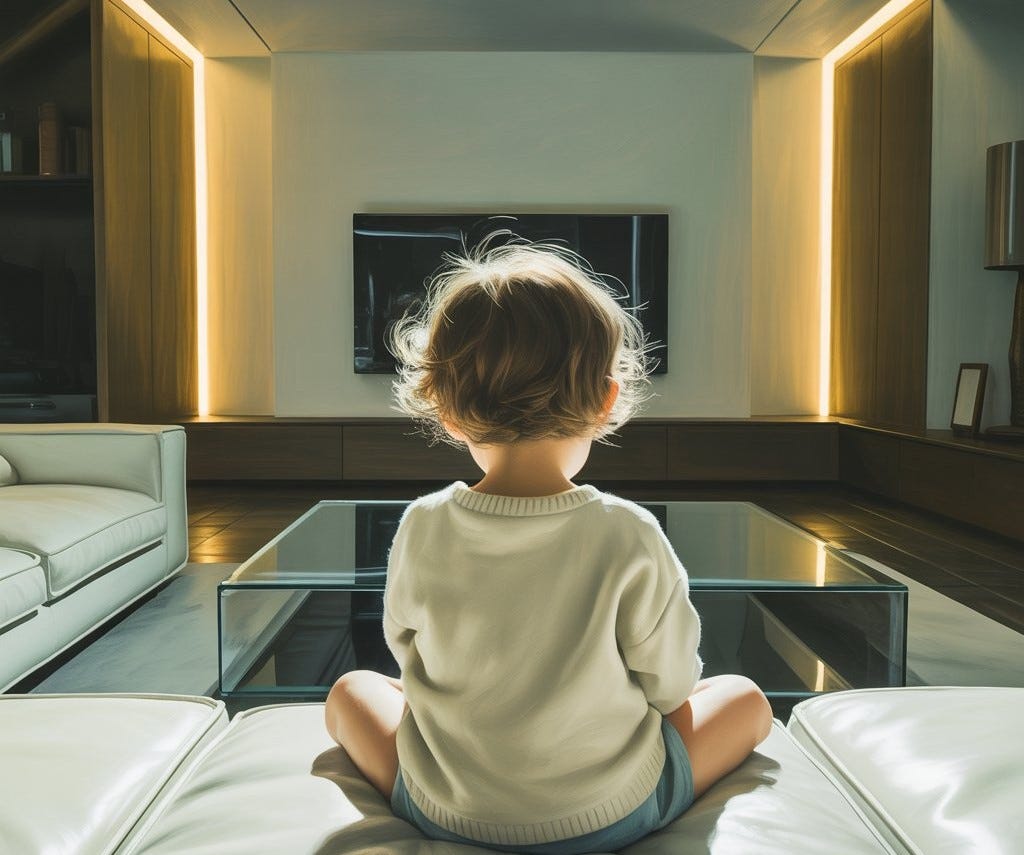
A Philosophical Essay on Technology, Formation, and the Loss of Human Wholeness
Preface: A Morning in a Smart Home
There is a particular kind of morning happening in millions of homes across the world. The lights ease on automatically, calibrated to the child’s sleep cycle. The thermostat has already decided the temperature. A voice answers questions before curiosity has fully formed. Breakfast arrives from a refrigerator that ordered its own groceries. The door unlocks itself. The car knows the way.
Nothing is hard. Nothing is slow. Nothing requires the child to figure anything out.
We call this a smart home.
And with all the development in cognitive science, we still have not understood how the environment — especially in early childhood — dictates the formation of a child’s total beingness.
We might ask whether this is ignorance.
Or whether it is deliberate.
Because a human being who understands process — who can grow food, find water, navigate by the stars, sit with silence, repair what is broken — is a human being who needs very little. And a human being who needs very little is a problem for an economy that requires them to need everything.
First, a need was created for food. Then for warmth. Then for entertainment. Then for information. Now, finally, for the management of their own homes — the last space that was ever truly theirs.
The smart home is not just a product. It is the logical endpoint of a very long project — the steady, systematic removal of human competence, dressed at every stage as its opposite. As progress. As elevation. As care.
And we began with the children. Because children who grow up inside a system cannot understand, cannot operate, and cannot imagine living without — will become adults who never question it.
This essay is that question.
And this — all of this — is how we progressed human formation out of existence.
Before this story is told, one thing must be said clearly.
There is no villain in what follows. What happened was not the result of malice or conspiracy — it was the product of innocence. Of good intentions accumulating, over five centuries, into a structure that no one designed, no one predicted, and no one, standing inside it, could clearly see. The printing press was liberation. The school was generosity. The appliance was kindness. Each gift, offered sincerely, set in motion the next — until the gifts accumulated into a system whose consequences no single giver could have foreseen or intended.
The logic is what caused the harm. And a logic has no face to accuse.
What this essay asks of you is not guilt. It asks only for the willingness to look — clearly, without defense — at what the accumulation has produced. And to ask, seriously, whether this is what we would have chosen, had we understood where each gift was leading.
The Terrain of Loss
The children of the smart home are not losing just one thing. They are losing across every dimension of what it means to be human — and the losses do not sit separately beside each other. They interact. They compound. They cascade.
The child who has never inhabited his body fully cannot feel deeply. The child who cannot feel deeply cannot form genuine bonds. The child who has no genuine bonds cannot build a coherent self. The child without a coherent self cannot encounter meaning. The child who has never encountered meaning cannot orient toward anything larger than their own comfort.
Each loss opens the next. Together they do not describe a checklist of deficits. They describe a whole life — sensed, felt, thought, related, rooted, and wondered at — that has quietly gone unlived.
This is the lost child. Not lost in the dramatic sense — not visibly suffering, not obviously damaged. Lost in the quieter, more total sense of a human being who has been formed by an environment that asked nothing of them, and who has therefore become, in the most precise meaning of the word, nothing.
To understand what is being lost, we must look across the full terrain of human development — not as separate categories but as a single living whole whose parts sustain each other:
The sensory — the richness of a world encountered through a body that touches, lifts, smells, tastes, and tangible properties of real things.
The emotional — the capacity to feel deeply, to sit with difficult feeling, to move through it and emerge knowing oneself better for having done so.
The physical — the experience of being genuinely embodied: tired, capable, hungry, strong, present in space and time in ways that no screen can simulate.
The psychological — the slow formation of a coherent self, built not from preferences and profiles but from encounter, effort, failure, and recovery.
The developmental — the natural trajectory toward adulthood, in which each stage of challenge met prepares the ground for the next.
The cognitive — the capacity to think independently, to sit with complexity, to tolerate not knowing long enough for genuine understanding to emerge.
The relational — the bonds of true intimacy, built through time, presence, vulnerability, and the willingness to be genuinely known by another.
The social — the skills of genuine connection: negotiation, repair, patience, the ability to be in community with people one did not choose.
The cultural — the roots of identity and belonging, the sense of coming from somewhere, of being part of a story that began before you and will continue after.
The existential — the encounter with mystery, with mortality, with questions that have no answer and yet must be lived with fully.
The spiritual — the orientation toward something larger than the self: toward transcendence, toward the sacred, toward the felt sense that existence is not merely a problem to be managed but a gift to be received.
These are not eleven separate losses. They are eleven expressions of a single loss — the loss of a life lived in full contact with reality; with the world as it actually is; with other human beings as they actually are; with the self as it is actually capable of becoming.
The chapters that follow examine how this loss happened, why it was allowed to happen, and what it means that we have built, in the place of that full life, a home intelligent enough to ensure our children never have to find out what they were capable of.
Chapter One: The Myth of the Smart Home
Consider what the word smart actually means. A smart home is responsive — it reads its environment and reacts. It is self-regulating — it corrects itself without being asked. It is anticipatory — it solves problems before they become problems.
Pause there.
Responsive. Self-regulating. Anticipatory. These are not architectural qualities. They are the central achievements of human cognitive development — the very capacities that a child spends the first twenty years of life slowly, effortfully, incompletely acquiring.
The smart home has claimed those capacities for itself. And the child living inside it is, as a consequence, quietly excused from the need to build them. Everything the home does is everything the child no longer needs to do. Everything the home becomes is everything the child no longer needs to become.
We have not built a smarter home. We have built a home that is smart so that its children do not have to be.
What the Smart Home Claims to Be
The smart home arrives with a set of promises so reasonable, so warmly expressed, that to question them feels almost ungracious. It offers freedom. It offers elevation. It promises to remove unnecessary burden and to deliver us to the logical destination of everything progress has been working toward.
Each of these promises deserves to be looked at directly. Because the most consequential errors are never the ones that sound wrong. They are the ones that sound exactly right.
Freedom — from what? From the very encounters that taught us who we are. From the effort that built our minds. From the processes that connected us to reality. This is not freedom. It is an amputation sold as liberation.
Elevation — if the environment shapes a being, and a frictionless, automated, instantly responsive environment produces a fundamentally different kind of human, is that elevation? Or is it a carefully designed diminishment that does not know it is one?
Removing unnecessary burden — but who decided what was unnecessary? The child carrying water saw where water comes from, experienced the effort, felt the community, and saw the consequence. Was that a burden? Or was that formation?
Progress toward what? If the endpoint is a human who cannot navigate without GPS, cannot tolerate silence, cannot understand where water comes from, cannot sit with discomfort — what exactly have we progressed toward?
The Philosophy Embedded in the Design
The smart home is not neutral furniture. It is an environment with a philosophy — one that says the world should conform to you, that waiting is failure, that process is waste, that the self is a preference-set to be catered to.
Children absorb that philosophy before they can question it. It becomes the invisible architecture of their being. And the self that forms inside it is a self, shaped by a very particular set of assumptions about what a human being is:
A preference-set to be catered to. An individual whose comfort is the organizing principle of the space.
Not a participant in life. A consumer of it.
Chapter Two: The Environment Has Always Been the Curriculum
For most of human history, the environment made demands. It resisted. It withheld. It required effort, attention, patience, and ingenuity simply to move through a day. Children growing up within that alive world were not suffering a deficit of comfort — they were receiving an education so total, so embodied, so continuous, that no school could replicate it.
The world itself was the curriculum. And the lesson, absorbed through ten thousand daily encounters with a real and alive world, had no words. It was not a thought about the self. It was something older and quieter than thought:
The world guides me, responds to my efforts, leads me towards understanding. I am not the author—only a participant in something larger, already moving.
The smart home quietly revokes that lesson. And in its place offers something that looks like its superior — ease, abundance, instant response — but may be, in the deepest sense, a form of deprivation we do not yet have the language to name.
The Neuroscience of Environment-Dependent Development
The human brain is the most unfinished organ at birth of any species on earth. A foal stands within hours. A human child cannot walk for a year, cannot speak coherently for two, cannot regulate its own emotions for seven, cannot exercise full executive function until their mid-twenties.
This is not weakness. It is evolutionary strategy.
The human brain is designed to be completed by the environment. It arrives unfinished deliberately — so that it can be shaped by the specific world it is born into. So that it can become precisely the kind of mind that world requires.
This means something profound and irreversible: the environment does not influence development. The environment is development.
Every texture an infant touches is building somatosensory maps. Every sound is laying down phonemic architecture. Every frustration navigated is building the neural circuits of emotional regulation. Every physical challenge met is developing the cerebellum, the motor cortex, proprioception. And every process observed — water being fetched, fire being built, food being grown and prepared — is building causal reasoning: the deep understanding that the world operates through chains of cause and effect that a competent person can understand, navigate, and influence.
Remove the environment. Remove the development. It is not metaphor. It is neuroscience.
The Black Box Generation
Previous generations grew up with legible technology — you could see how things worked. A wood stove taught that fire needs fuel and air. A hand pump taught that effort produces water. A dial thermostat meant you physically moved something to get warmth.
Smart homes are radically illegible. The child says a word, and light appears. There is no comprehensible mechanism. It might as well be magic.
The danger of magic is that it teaches you nothing. It just works — until it doesn’t, and then you are helpless.
What gets lost when process disappears? Mechanical intuition — the understanding that effort produces outcomes, that systems have parts, that things can break and be fixed. Proportionality — the knowledge that bigger outcomes require bigger effort. Patience baked into process — the natural rhythm that physical tasks imposed on childhood. And the sense of personal agency — the felt difference between I turned on the light and the light came on when I spoke. One locates the child as the cause. The other makes them a trigger in a system they do not understand and did not build.
Chapter Three: The Long Project
From Gutenberg’s Press to Alexa’s Voice — How Human Competence Was Slowly Taken, and Sold Back
This did not happen all at once. It happened in stages — each one celebrated as liberation, each one quietly extracting something fundamental from the human being. And each stage followed the same pattern: identify a human competence, create a product or system that performs it instead, narrativize the replacement as progress, wait one generation until the original competence is forgotten, and the dependency becomes invisible because no one remembers the alternative.
This is not conspiracy. It is the internal logic of capital meeting the vulnerability of human adaptability. We adapt to what the environment offers. And when the environment is shaped by commercial interests, we adapt toward dependence.
The First Severance: When Knowledge Left the Body
Before the printing press, knowledge lived in the human being.
Not in books. Not in institutions. Not in any external repository that could be consulted, referenced, or searched. Knowledge lived in the body, in the memory, in the practiced hand, in the spoken word passed from elder to child. It was inseparable from the person who held it and the community that sustained it. To know something was to be someone who knew it — in your hands, in your bones, in the living continuity of a tradition you had been born into and would pass on.
This was not a limitation. It was the most intimate and complete relationship between a human being, their knowledge, and the living context they inhabited that has ever existed. The healer who knew the properties of plants knew them through decades of handling, observing, and applying. The farmer who knew the soil knew it through generations of family memory accumulated in a specific place. The elder who knew the community’s history knew it because they had lived inside it and were responsible for carrying it forward. Knowledge and knower were one.
Then came the printing press.
The Gutenberg revolution of the fifteenth century is celebrated, rightly, as one of the great turning points in human history. It broke the monopoly of the church and the court over what could be known and by whom. It made possible the Reformation, the Scientific Revolution, the Enlightenment. These are genuine achievements. But there is a fundamental misunderstanding at the heart of how we remember this moment.
What the printing press enabled was access to information. Not to knowledge. And information is not knowledge.
The church and the court had held a monopoly over information — over doctrine, law, and the officially permitted account of reality. What the printing press broke was that monopoly. This was genuinely liberating — for information.
But existential knowledge was never the church’s to monopolize. It was never held in cathedrals or courts. It lived in the body of the midwife and the hands of the farmer. In the memory of the elder and the practice of the healer. In the woman sitting at the fire with her daughter beside her, learning through presence what no text has ever transmitted. Existential knowledge has one defining characteristic that separates it absolutely from information: it can only be understood by experiencing it. You cannot read your way to it. You cannot receive it from a text. It exists only inside the living experience of the person who has undergone it — and it disappears, without remainder, when the experience is no longer lived.
The printing press did not threaten the church’s monopoly over this knowledge. The church never had it.
What the printing press did — quietly, without intention, without anyone noticing — was something far more consequential. By establishing the written word as the definitive form of knowledge, it made existential knowledge invisible. Not destroyed. Not forbidden. Simply unrecognized. Unnamed. Placed beneath the new threshold of what counted as knowing.
The book made experience optional. Over generations, it made experience irrelevant. If something was written down, it did not need to be carried inside you. The living relationship between the knower and the known — the relationship that had, for all of human history, required presence, practice, and embodied transmission — was replaced by a relationship between a reader and a text. Between a self and an external object that contained what the self no longer needed to carry. And in the same gesture, reason itself was externalized. Reason had always been embedded in the body — in the farmer’s hands reading the soil, in the healer’s nose reading the plant, in the elder’s eyes reading the sky. Now it migrated to the page. And the body, its primary instrument gone, began its long recession from the center of human knowing.
The Two Languages
This is where a distinction must be made that modernity has almost entirely lost — the distinction between two fundamentally different types of language.
There is experiential language. And there is mental language. They are not points on a spectrum. They are qualitatively different modes of expression that activate different dimensions of the human being and produce different kinds of knowing.
Experiential language activates the body and the senses. When someone says eat rice and raw mangoes, but less salt — every word arrives with sensory content. Rice is a smell, a texture, a warmth, a particular satisfaction in the body after eating. Raw mango is sharp, sour, cooling, immediate on the tongue. Salt is felt before it is understood. The language and the experience are continuous with each other. The body knows exactly what is being said because the body has been there. No education is required. No institutional permission. Only a body, and the lived experience the words are pointing toward.
Mental language activates the mind alone. When someone says have more carbohydrates, less protein, include vitamins — these are abstractions. Taxonomic categories constructed by nutritional science to organize food into a conceptual system. No one has ever tasted a carbohydrate. No one has ever smelled a vitamin. These words have no sensory referent. They exist only as concepts requiring prior education to decode. The body is not addressed. The body is not even present.
The grandmother who spoke in rice and mangoes and salt held sovereign knowledge. It was transmissible without literacy, without institutional access, without any authority beyond the lived experience of feeding her family well. It was verifiable by anyone who ate what she cooked and felt what it did to their body. Her knowledge was democratic in the deepest sense — not because an institution declared it so, but because reality itself is democratic. The fire burns for everyone. The rain falls on everyone. The knowledge of how to live well in a body was available to every human being simply by virtue of being alive, embodied, and embedded in a community.
The nutritionist who speaks in carbohydrates and vitamins holds institutional knowledge. It requires years of formal education to produce and decode. Its authority resides not in the body’s verification but in the credential, the journal, the institutional apparatus that certifies what counts as legitimate nutrition science. And it is revised, contradicted, and overturned with remarkable regularity — because it is constructed within a conceptual system that is answerable to its own internal logic rather than to the ten-thousand-year accumulated wisdom of human bodies eating food in specific places and seasons.
What happened when mental language replaced experiential language was therefore not merely a change in vocabulary. It was a political act. Every time a grandmother’s knowledge was retranslated from rice and mango and salt into carbohydrates and vitamins and sodium, something was taken. Not just the warmth of the language. But the grandmother’s authority over her own domain. Because in the new language, she is not an expert. She is uneducated. And her knowledge, which cannot be expressed in the approved vocabulary without losing everything that made it knowledge, becomes invisible to the institutions that now govern the domain of food.
Invisible knowledge is undefended knowledge. It can be dismissed, replaced, and forgotten — not through argument, but through the establishment of a language in which it cannot be spoken.
What Literacy Actually Did
Modernity’s most sacred and unexamined claim is that literacy democratized knowledge. This claim is the foundational justification for universal education, for the printing press as liberation, for the entire project of modern knowledge institutions. And it is, in the most precise and important sense, false.
Literacy did not democratize knowledge. It destroyed the only knowledge system that was ever genuinely democratic — and replaced it with access to a hierarchy, while calling the access democracy.
Before literacy, the illiterate farmer, the unschooled grandmother, the community elder who could not read a single word — held genuine epistemic authority within their domain. They knew things. Real things. Things that could be verified by anyone who lived the same life, in the same place, with the same attention. Their knowledge was not dependent on institutional validation because it did not need institutional validation. Reality itself validated it. The crops grew. The family was fed. The medicine healed. The community survived.
After literacy, those same people were reclassified. Not as holders of a different kind of knowledge — but as uneducated persons. As people who did not yet have knowledge. Who needed to be brought into the knowledge system through schooling. Their actual knowledge — which had not diminished by a single gram — was rendered invisible. Not attacked. Not disproven. Simply placed outside the category of what counted as knowing.
And this reclassification was experienced not as an act of violence — which it was — but as an offer of generosity. Come, we will teach you. Come, we will give you access to knowledge. Come, join the literate world. The farmer who accepted that offer — who sent their children to school, who began to feel ashamed of what the grandmother knew because it could not be expressed in the new authoritative language — did not gain knowledge democracy. They surrendered the only knowledge democracy they had ever had.
Every generation was then told that the knowledge being taken was primitive. That the dependency being created was liberation. That the competence being lost was unnecessary — in fact a superstition. That this — all of this — was science and progress.
From that moment, the slow erasure could proceed. Not by force. By definition. If knowledge is what can be written down — then what cannot be written down is not knowledge. It is tradition. Custom. Folklore. Superstition. And a civilization that cannot name what it is losing cannot mourn it, defend it, or pass it on.
The Stages of the Project
What followed the printing press was not a single event but a cascading logic — each stage made possible by the previous, each one following the same pattern of extraction, replacement, and narrativized liberation.
The book moved knowledge from the living intelligence of the human body onto the static surface of the page — and made experience optional. The school moved children from the living context of family and community into the managed institution — and made the world outside the window irrelevant to the business of learning. The child who had once learned by doing, by standing beside the elder, by handling the tool, by participating in processes that mattered, was now seated and still, receiving the contents of books from a teacher who had read them. The body was managed and contained. The hands were folded.
The factory moved making from the home and the craft workshop into the industrial system — and made the understanding of how things are produced unnecessary for those who consumed them. The object lost its internal logic. It could no longer be understood, maintained, or restored by the person who used it. It could only be replaced.
Water: Before, it was carried, rationed, stored with care. Every drop had a traceable origin — the well, the river, the rain. Children saw where water comes from, experienced the effort, felt the community, and saw the consequence. The cognitive and moral lessons embedded in this were not taught. They were lived. Resources are finite. Effort has value. Waste has consequences. Gratitude is rational, not sentimental. Now a tap produces unlimited, invisible water. The process — aquifers, treatment plants, pipes, pressure systems — is completely hidden. Water is not a resource. It is a feature. What was lost is not merely a conservation habit. It is the entire cognitive framework of resource consciousness — the understanding that everything has an origin, a cost, and a limit.
Fire and heat: Heat once required gathering wood, understanding dry versus wet fuel, building and maintaining a fire. Children read fire through their hands — not as a subject, but as survival. The fire going out had real consequences. It summoned attention in a way no classroom has ever replicated. Now a thermostat produces warmth from nowhere. The consequence is removed. And with the consequence, the attention it produced — total, embodied, self-sustaining, generated not by instruction but by the reality of what was at stake.
Food: Growing, harvesting, and preserving food was central to childhood experience across all cultures. Children understood seasons, soil, failure, and patience. A bad harvest was a lesson in reality that no examination could simulate. The chain from seed to plate was not just visible — it was participated in. The child was not a consumer of the cycle. They were part of it. Making: clothing was made and mended, tools were sharpened, homes were maintained by their inhabitants. Making something gave you an understanding of its structure and value. The concept that objects have internal logic — that they can be understood and restored — was transmitted through daily practice, hand to hand, generation to generation.
Navigation: Getting somewhere required reading landscapes, stars, landmarks, and the accumulated geographical knowledge of a community rooted in a specific place. Children internalized geography through physical experience. Getting lost was a teacher. Studies already show measurable decline in hippocampal navigation ability in GPS-dependent adults. The organ that builds maps of the world is shrinking from disuse.
The Advertising Tells the Story
The advertising of the early twentieth century — selling canned food, electric appliances, manufactured goods — did not merely say this is convenient. It said: this is what modern people do. This is what intelligent families choose. The old ways were backward, exhausting, beneath you.
The message was not just commercial. It was psychological warfare against competence conducted in the language of liberation. It told people that what they knew how to do — what their mothers and grandmothers knew — was embarrassing. Primitive. A mark of poverty and ignorance.
And it worked. Because it came wrapped in the logic that had been established five hundred years earlier, when the printing press first placed mental language above experiential language, and institutional knowledge above the knowledge that lived in the body. The advertising did not invent this hierarchy. It simply exploited it — with extraordinary commercial precision.
The freedom offered was freedom from competence. Freedom from process. Freedom from the knowledge that had, for millennia, been the source of genuine sovereignty. And each competence taken was a need created — a market opened, a dependency established, a generation raised without the knowledge that would have made them self-sufficient.
Within two generations, it was gone. Not forgotten gradually. Gone — because the environment that required it no longer existed. And the children growing up in the new environment had no idea what had been lost, because they had never seen it. Because the language in which it could have been named — the experiential language of rice and mango and salt, of fire and water and effort and consequence — had been replaced by a mental language in which the loss could not even be articulated.
The Smart Home as Completion
The smart home did not invent this condition. It inherited it — and perfected it.
The child growing up in an automated home is the furthest point yet reached in a journey that began the moment Gutenberg’s press produced its first page: the progressive migration of knowledge from the human body into external systems, until the body itself becomes unnecessary to the business of living. From that first outsourcing of memory to the final outsourcing of the home itself — the same logic, five hundred years, one unbroken project.
We called it literacy. We called it enlightenment. We called it the democratization of knowledge. And in the same gesture, without meaning to, we began the long slow process of emptying the human being of everything they once knew how to do — and of the language in which that knowing had always been carried, transmitted, and kept alive.
A need was created for food. Then for warmth. Then for making. Then for entertainment. Then for information. Now, finally, for the management of the home itself — the last space that was ever truly theirs.
And at every stage, the same justification was offered. Every generation was told that the knowledge being taken was primitive. That the dependency being created was liberation. That the competence being lost was unnecessary — in fact a superstition. That this — all of this — was science and progress.
Whether a civilization intelligent enough to build all of this is wise enough to understand what it has done — that is the question the remaining chapters of this essay must face.
Interlude: A Note on Innocence
There is no villain in this story.
This must be said — now, after the historical argument has been made, when the weight of what was taken is most fully felt and the temptation to assign blame is at its strongest. Because the argument that precedes this page can be misread as an accusation. And it is not.
The monk who copied manuscripts did not intend to gatekeep knowledge. The printer who ran the first press did not intend to make experience optional. The schoolteacher who asked the child to sit still and listen did not intend to sever them from the living world. The engineer who designed the smart thermostat did not intend to produce a child incapable of tolerating discomfort. Each of them was doing what seemed, within the logic available to them, not merely reasonable but genuinely good. Each believed, sincerely, that what they were offering was better than what came before.
Modernity is not a conspiracy. It is something more interesting — and more troubling — than a conspiracy. It is the accumulated product of innocence. Of ten thousand good intentions, each locally sensible, whose cumulative effect no single actor could see because no one was standing far enough back to see the whole. One thing led to another. And another. And this — five centuries later — is where we have arrived.
What makes this so difficult to confront is not that people are malicious. It is that the hierarchy created by this accumulation has become a default setting — running quietly and automatically in the background of every educated mind, requiring no conscious endorsement, perpetuating itself without anyone choosing to perpetuate it.
The educated person who feels, with a faint and uncomfortable certainty, that the grandmother’s knowledge is less rigorous than the nutritionist’s — does not choose that feeling. They were formed by a system that placed one kind of knowing above the other before they were old enough to question the arrangement. The hierarchy was installed. And installed hierarchies do not announce themselves. They simply run — shaping perception, distributing respect, determining whose knowledge counts and whose does not — as invisibly and automatically as the smart home maintaining the temperature of a room whose occupants never think to ask how the warmth arrives.
This is what makes the situation so grave. Not that people are unwilling to change. But that the hierarchy operates below the threshold of willingness. It is not a prejudice that can be argued away. It is a formation — as deep and as prior as the language we think in. The instinct, shared by almost everyone who has passed through a modern education, that the written, the certified, the institutionally validated is simply more trustworthy than what the body knows, what the community carries, what the grandmother understood without being able to say how — that instinct was not chosen. It was installed. Quietly. Over years of schooling that rewarded one kind of knowing and rendered another invisible.
And here is the final and most uncomfortable turn of this observation: the people most thoroughly formed by this hierarchy are also, by definition, the people least able to see it as a hierarchy rather than simply as reality. The more completely a person has been educated within the system — the more successfully they have internalized its categories, mastered its language, ascended its ladder — the more naturally its assumptions feel like truth rather than convention. The default setting is experienced most completely as nature by those in whom it has been most completely installed.
This is not cynicism. It is a precise and compassionate account of how civilizational change actually works. The logic shaped the people. The people perpetuate the logic. Not from malice — from formation. Not from choice — from default.
To see this clearly — to see that the hierarchy is a setting and not a truth, that it was installed and not discovered, that it serves a particular historical arrangement of knowledge and power rather than simply reflecting the way things are — is the first act of genuine intellectual freedom available to a modern educated person.
And it is also, genuinely, one of the hardest things that can be asked of anyone.
Because it requires looking carefully at the very instrument with which you are doing the looking — the educated mind itself — and asking whether what it sees as inferior might simply be what it was trained not to recognize as knowledge.
That is not a comfortable question. It is not meant to be.
But it is the question this essay is built upon. And the chapters that follow — on the kitchen, on collective beingness, on boredom, on education, on the smart home as the culmination of all of it — can only be read clearly by someone willing to hold that question open.
Not with guilt. Guilt is too easy, and too self-referential, to be useful here.
With curiosity. With the willingness to look at what you have inherited — and to ask, seriously and without defense, whether you would have chosen it, had you been given the choice.
Chapter Four: The Kitchen — Where Life Was Made and How It Was Taken
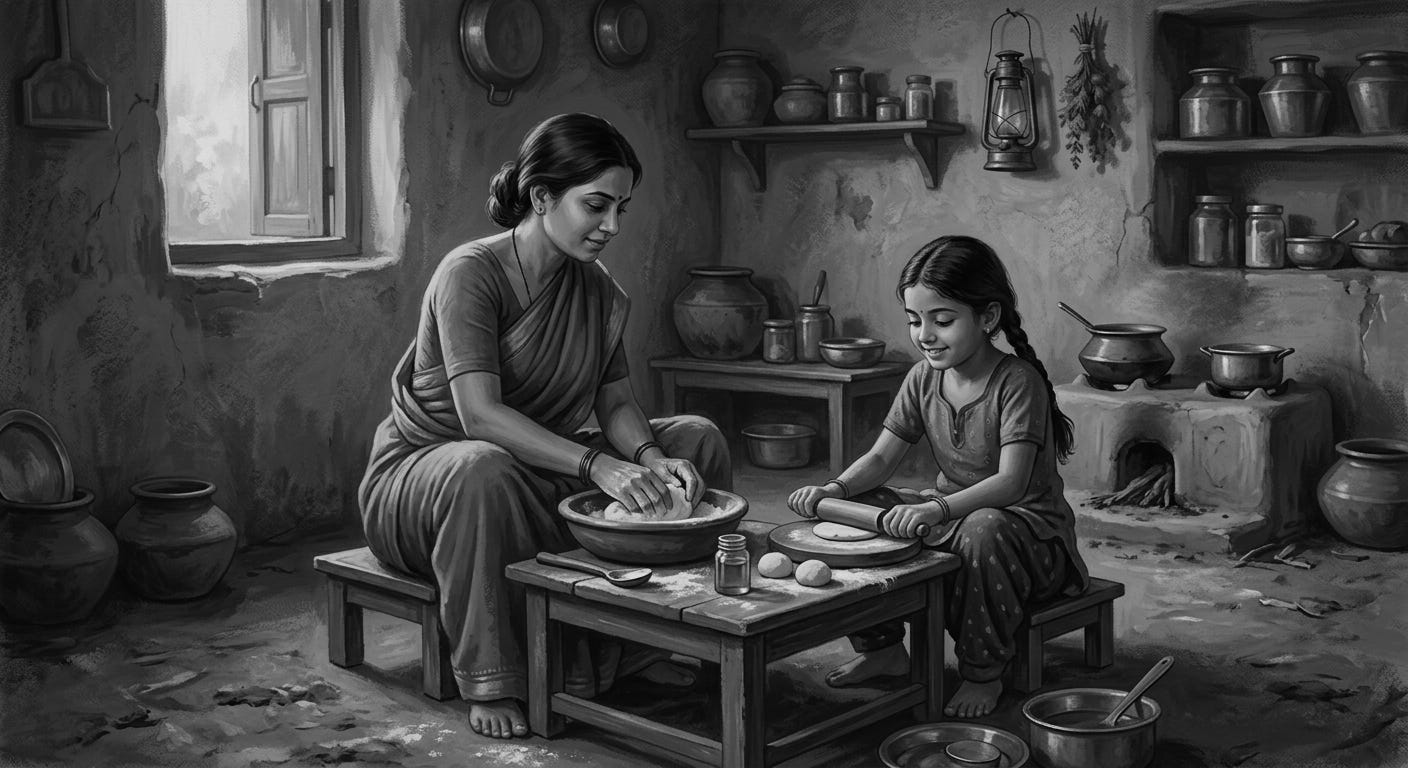
Of all the spaces that modernity dismantled, none was more central, more sacred, or more consequential than the kitchen.
In every culture that has ever existed on this earth, the kitchen was not merely a room where food was prepared. It was the axis around which life turned. The place where the most fundamental knowledge was held, practiced, and transmitted. Where the chemistry of fermentation, the biology of nutrition, the mathematics of rationing and proportion, the science of preservation, and the philosophy of nourishment all lived together — not as subjects, but as daily acts performed by human hands with profound understanding of what they were doing and why.
The kitchen was a laboratory, a classroom, a temple, and a community center simultaneously. And the person at its center — in most cultures, the woman — was not a domestic servant. She was the primary life-giver of the society. Not metaphorically. Literally. She was the one who understood what the body needed, what the season provided, what the sick required, what the growing child must eat, what the elder could digest. She held the nutritional intelligence of the entire community in her hands and her memory.
To call this a limited role is to misunderstand it completely. It was the most consequential role in any society. Because everything else — the strength of the warriors, the wisdom of the elders, the vitality of the children, the endurance of the workers — depended entirely on it.
What the Kitchen Actually Was
Walk into the kitchen of any traditional culture and you were walking into a space of extraordinary sophistication.
The Indian kitchen held knowledge of six tastes and their relationship to the body’s constitutions, the medicinal properties of dozens of spices, the science of combining foods for maximum nutritional effect, the art of fermentation that produced probiotic-rich foods thousands of years before the word probiotic existed. The woman who ran that kitchen was a practicing nutritional scientist, a pharmacist, a microbiologist — without any of those titles, and with a depth of practical knowledge that most holders of those titles today do not possess.
The traditional Mexican kitchen held the knowledge of nixtamalization — the process of treating corn with mineral lime that unlocks its full nutritional profile and prevents deficiency diseases. This knowledge, held by indigenous women for thousands of years, was so sophisticated that modern nutritional science took centuries to understand why it worked. The West African kitchen held knowledge of combining grains and legumes in proportions that created complete proteins. The Japanese kitchen held fermentation traditions that produced gut-healing foods of extraordinary complexity. The Mediterranean kitchen held an intuitive understanding of the relationship between food, oil, and the body that modern medicine has spent decades trying to articulate in clinical trials.
None of this knowledge was written down. None of it was certified. None of it was considered, by the institutions of modernity, to constitute real knowledge at all. It was held in hands. In memory. In practice. In the relationship between a mother and a daughter sitting together leisurely. And it was, by every meaningful measure, among the most sophisticated bodies of applied knowledge any human civilization has ever produced.
How It Was Taken away
The dismantling of the kitchen followed the same pattern as every other stage of the long project — but it was executed with particular brilliance. Because it required convincing women to voluntarily surrender the source of their most profound social power, and to experience that surrender as emancipation.
It began with the industrialization of food. Canned goods arrived in the nineteenth century, promising to free women from the labor of preservation. Then came refined flour, refined sugar, and factory bread — each presented as modern, clean, scientific, superior to the crude homemade alternative. The message embedded in every product was identical: what you make at home is inferior to what we make in our factories. Your knowledge is superstition. Our process is science.
Then came the processed food revolution of the mid-twentieth century. Ready meals. Instant everything. The complete outsourcing of food preparation to industrial systems. And with it, the most audacious campaign in modern history — one that did not merely sell products, but sold an entire ideology. It told women that cooking was oppression. That the kitchen was a prison. That a liberated woman was one who had been freed from the stove. That feeding your family from scratch was a waste of an educated mind.
The feminist movement — legitimate and necessary in its fight for equal rights, equal pay, and equal participation in public life — was on this one question subtly and catastrophically misdirected. Because the liberation being offered was not liberation from oppression. It was liberation from power; from knowledge; from the most consequential contribution any person makes to the health and formation of a society.
The woman who left the kitchen did not become freer. She became a customer. Her knowledge was not replaced by something better. It was replaced by a product. And the product was infinitely inferior — nutritionally, culturally, developmentally — to what she had been making with her own hands.
What Was Lost When the Kitchen Was Emptied
When the kitchen was dismantled, the losses were not merely nutritional — though those alone are catastrophic, visible in the epidemic of chronic disease, metabolic disorder, and childhood illness that has risen in precise proportion to the rise of processed food.
The transmission chain broke. For the first time in human history, a generation of children grew up without watching the full cycle of food preparation. Without learning, by proximity and participation, what food was, where it came from, what it required, what it gave back. Without absorbing, through the daily rhythms of the kitchen, that things take time, that nourishment requires care, that the body is not a machine to be fueled but a living system to be tended.
The community space dissolved. The kitchen in traditional life was never a solitary space. It was where women gathered, talked, taught, and held the social intelligence of the community. It was where the young learned from the old not just how to cook, but how to live — how to manage scarcity, how to care for the sick, how to mark celebration, how to hold grief. When the kitchen emptied, that transmission stopped. And the knowledge it held — accumulated over thousands of years of careful, loving, intergenerational attention — vanished within two generations.
The child lost its first teacher. Because the kitchen was, in every traditional culture, the first classroom. The place where children stood beside their mothers and received their earliest education in patience, in process, in cause and effect, in the satisfaction of making something real with their hands. The child who grew up in the kitchen grew up understanding that food was not a product. It was a relationship — between the earth and the plant, between the person who cooked and the people who would eat, between the living and the dead who passed down the knowledge of how.
The Smart Kitchen as Final Insult
The smart home completes what the processed food industry began. Now the kitchen itself — that last echo of the traditional hearth — is being automated. Smart ovens that cook by algorithm. Refrigerators that order their own groceries. Meal kit services that pre-measure every ingredient so that even the residual act of preparation requires no knowledge, no judgment, no understanding of what you are doing or why.
The kitchen has not been liberated. It has been emptied of everything that made it powerful and converted into a consumption terminal.
And the women who were told they were being freed from it — their granddaughters now pay companies to provide, in inferior form, exactly what their grandmothers knew how to do with sovereign mastery. They buy probiotic supplements instead of making fermented foods. They pay nutritionists to tell them what their great-grandmothers knew instinctively. They purchase processed baby food from factories, when every traditional culture understood that the first foods of a child were among the most consequential decisions of their formation.
The knowledge was not replaced. It was sold back. At a profit. In a degraded form. To women who were told that giving it up was progress.
This is the story of the kitchen. And it is, in miniature, the story of everything this essay has been about: the systematic dismantling of human competence, the manufactured need that replaced it, and the child left at the end of the process — inheriting a world that does everything for them, and therefore never teaches them anything at all.
Chapter Five: The Psychology of Abundance
What Indigenous Peoples Knew That We Have Forgotten
Here is the narrative modernity tells about itself: earlier people were poor and scarce. Modern comfort liberated them. Progress moved humanity from deprivation to abundance. Technology saved us from the brutishness of a life lived close to nature.
Every part of this narrative is wrong. And the wrongness matters enormously — because it is the foundation upon which every subsequent error has been built.
Indigenous and pre-industrial peoples did not experience their lives as lacking. They had enough water — because they lived within its natural rhythm. Enough food — because they understood seasons and stored accordingly. Enough warmth — because they knew how to make fire. Enough meaning — because every act of daily life was connected to something larger than itself.
They were not waiting to be rescued by technology.
The poverty was not in their lives. It was projected onto them — first by colonizers, then by development economists, then by the entire narrative architecture of progress.
Where Scarcity Actually Comes From
Scarcity as a psychological condition — as a permanent background anxiety — is a product of modernity, not a feature of pre-modern life.
When water, food, warmth, and shelter became commodities rather than relationships with the natural world, they acquired price tags. And price tags create the perpetual question: do I have enough money? Before monetization, you did not need money to be warm. You needed knowledge, skill, and community. Those felt abundant because they were abundant.
The idea of progress requires a before that was worse. Colonial and industrial powers needed to narrativize indigenous life as poor, backward, and insufficient — to justify intervention and extraction. Once that narrative took hold, people began to see themselves as poor. The psychological damage was precisely this: the colonization of the indigenous self-concept.
As process was removed — as people stopped making, growing, fixing, navigating — they became genuinely dependent on external systems. And dependence creates felt scarcity. Because now you truly are vulnerable to forces outside yourself. The scarcity became real after it was first imagined.
The Default Setting of Abundance
The feeling of abundance does not come from having much. It comes from needing little and knowing how to provide it.
When you know how to find water, grow food, and build shelter — you move through the world with a deep, unshakeable groundedness. Not arrogance. Competence. You are not dependent on systems you don’t understand. You are not one power outage away from helplessness.
When every task is a participation in life itself — grinding grain, tending fire, raising children within a community that holds them — you are not experiencing drudgery. You are experiencing belonging to a process larger than yourself. Indigenous cultures almost universally had a concept of enough. Not because they were saints, but because their relationship with resources was direct and legible. You could see when there was enough.
Modern consumer culture requires you to never feel enough — because the economy depends on perpetual dissatisfaction. The smart home is the latest and most intimate version of this arrangement: a device that continuously implies your current environment is insufficient and needs adjustment.
Chapter Six: The Fragmentation of Collective Beingness
We did not evolve into individuals who then chose to form collectives. We evolved as collective beings who, under very specific historical and economic conditions, were separated into individuals — and told that this separation was called freedom.
The child born today inherits that separation as nature. As the way things are. As the only way things could be. And the smart home — humming quietly around them, calibrated to their every preference — confirms it daily.
You are the center. You are alone. And this is called comfort.
The Biology of Collective Being
Collective beingness is not a political choice or a cultural preference. It is the natural way of being. You are born biologically into a collective being.
The infant’s nervous system is not self-regulating. It co-regulates with the mother’s nervous system. The mother’s heartbeat, breathing, warmth, and voice are not comforts. They are biological necessities. The infant’s brain literally cannot regulate itself without the presence of another. This is not dependency in the pejorative sense. This is the architecture of human biology declaring its nature.
Mirror neurons — discovered in the 1990s — fire not only when we perform an action but when we observe another performing it. The brain does not sharply distinguish between self and other at the neurological level. It resonates. It mirrors. It participates in the experience of others automatically, involuntarily, constitutively. We are literally built to feel what others feel.
We are not individuals who become social. We are social organisms who develop the capacity for individuation — gradually, partially, and always in relationship. The collective is not something we join. It is something we are born from and remain within.
Physically Individuated, Psychologically Collective
This is the sentence that dismantles the foundational error of modernity.
The body is individual in its boundaries. Each of us arrives in a single body, lives a single life. That is physically true and permanently true. But the interior of that body is constitutively social. The self that lives inside it was formed by others. Thinks in a language made by others. Feels emotions named by others. Knows itself only in the mirror of other selves.
Modernity looked at the individual body and made a philosophical leap: separate body means separate self, separate self means separate interests, separate interests make competition natural, and the market becomes the expression of human nature. This is the foundational logic of capitalism, liberal individualism, and the smart home.
But the leap was wrong. Separate body does not mean separate self. It means something far more interesting: a self that is uniquely located — in this body, this place, this ancestry, this moment — but constitutively connected to everything and everyone that formed it.
Physically individuated. Psychologically collective.
The Way the Whole Contains the Parts
There is a principle older than any philosophy, confirmed by every wisdom tradition and now being rediscovered by complexity science and systems biology: the whole contains the parts.
Not as a container holds objects — passively, externally. But as the body contains the cell — giving it its nature, its function, its meaning, its very possibility of being what it is. The cell outside the body is no longer a cell. It is matter that has lost its wholeness. The human being outside the collective is no longer fully human. They are an individual that has lost their context.
You are not a self who then joins a family. You are a self because of a family. You are not a person who then joins a community. You are a person whose very personhood was called forth by a community. Remove the individual from the collective and what remains is not a free individual. What remains is a fragment.
The indigenous child knew this not as philosophy but as daily reality. Their single body moved through a world of continuous relationship — held, witnessed, needed, known. Physically one. Psychologically woven into many.
The smart home child is the opposite. Physically held — in the most comfortable, responsive, perfectly calibrated environment human ingenuity has yet produced. And psychologically alone in a way that no previous generation of children has ever been.
What Modernity Replaced the Collective With
Modernity did not eliminate the need for collective beingness. You cannot eliminate a biological reality. It simply failed to provide it — and then created a market for the resulting emptiness.
The wound of collective severance produces loneliness — now epidemic, officially a public health crisis. It produces the hunger for followers, likes, and validation — the desperate performance of a self that has no witnesses who truly know it. It produces addiction to belonging-substitutes: gangs, cults, tribes, online communities, brand loyalty. It inflates romantic love — one person asked to provide what an entire village once gave. And it built the therapeutic industry — professional relationships that simulate the holding that community once provided naturally.
Every one of these is a market. And every one of them is a poor substitute for the real thing — because the real thing cannot be purchased. It can only be lived, in genuine, committed, long-term, embodied community with others.
Chapter Seven: The Formation of Total Beingness
What It Actually Takes to Become Fully Human
There is a question so basic that modern science, in its fragmentation into disciplines, has almost forgotten to ask it: what does it take for a human being to fully become one?
Not to survive. Not to function. Not to perform adequately in school or economy. But to become — in the fullest sense — a conscious, grounded, capable, feeling, meaning-making human being.
The answer, emerging from neuroscience, developmental psychology, anthropology, philosophy, and the accumulated wisdom of every culture that has ever raised children, is the same: the human being becomes through encounter with a real, demanding, and legible world — beginning from the first moments of life. Not through comfort. Not through protection from difficulty. Not through the removal of friction. Through encounter. Through resistance. Through process.
The Critical Windows Nobody Is Talking About
Developmental neuroscience has identified critical and sensitive periods — windows in early childhood during which specific capacities are formed, and after which their formation becomes dramatically harder. We talk about these windows when it comes to language acquisition and attachment. We do not talk about them — and we urgently should — in relation to the capacities the smart home most directly erodes.
Agency and causal reasoning develop most critically between birth and seven years. This is when the child builds their foundational understanding of themselves as a cause in the world. Every act of figuring something out, every successful navigation of a physical challenge, every encounter with consequence — lays down the neural architecture of confidence in one’s own efficacy. This is not self-esteem in the modern therapeutic sense. It is the body’s knowledge that I act and the world responds. A child whose environment acts for them — anticipates, adjusts, responds before they have fully acted — receives a different message at the neurological level: the world does not need you to figure it out.
Frustration, tolerance and emotional regulation build between two and ten years. The capacity to sit with discomfort, to persist through difficulty, to recover from failure — is not a personality trait. It is a learned neural capacity, built through repeated experience of encountering frustration and moving through it. The smart home systematically eliminates the low-level frustrations through which this capacity is built. These are not inconveniences. They are the gymnasium of emotional regulation. Remove them during the critical window, and the capacity does not merely go unexercised. It goes unbuilt.
Meaning-making through process develops throughout childhood. Meaning is not something given to children. It is something they construct — through participation in processes that have visible purpose, tangible outcome, and connection to the lives of others. Helping prepare food the family will eat. Fetching water that will be drunk. Making something with hands that will be used. These experiences build the felt knowledge that my actions matter to others. That I am not merely a recipient of the world’s services but a participant in its continuation. The smart home offers children a daily life of pure reception. A guest does not develop a sense of contribution. A guest consumes.
The Self That Full Formation Produces
When a child grows up in an environment that demands, teaches, resists, and rewards effort — a particular kind of self emerges. It has been described differently across cultures and centuries but its features are always the same.
Groundedness: a settled, unperformative confidence that comes not from being told you are capable but from having discovered it through experience. The body knows what it can do. The mind trusts itself to figure things out. The self does not need constant external validation because it has an internal reference point built from real experience.
Resilience: not the modern corporate resilience — bouncing back with positivity. But the older, truer resilience of someone who has encountered difficulty before and knows they can move through it. Difficulty is not catastrophe. It is the texture of a real life.
Presence: the capacity to be fully in the moment — not as a meditative achievement but as a natural state. Because the moment makes demands. Because the fire needs tending, the crop needs reading, the child needs feeding. The present is compelling because it is real and consequential.
Belonging: perhaps the deepest quality of all. The sense — not thought but felt, in the body — of being at home in the world. When you understand where water comes from, when you have participated in the cycle of food, when you know how to make fire and repair what is broken — you are not a stranger in the world. You are native to it.
The smart home child is a stranger in their own home. Everything works. Nothing is understood. The world is a service, not a home.
Chapter Eight: The Role of Education in the Destruction
If the smart home is the final stage of the project, formal education is its most powerful engine. Because education should be the place where the question — what does it mean to be fully human? — is asked most seriously. Instead, it became, with extraordinary efficiency, the place where that question is systematically answered in the wrong direction.
How the School Fragments the Human Being
The modern school separates the child from their body. Learning happens sitting still. The body is an inconvenience, managed and contained. But the body is not separate from intelligence — it is intelligence. Embodied cognition is not a supplement to real thinking. It is its foundation. Indigenous education happened in movement, in the field, in the forest, in the workshop. The hands and the mind were never separated because they are not, in reality, separate.
The school separates knowledge from application. You learn about water in a classroom. You never fetch it. You learn about plants in a textbook. You never grow them. You learn about community in a civics lesson. You never experience it. Knowledge becomes abstract — floating free of any connection to real process, real consequence, real life. And abstract knowledge does not form the self. It informs it, at best. At worst, it creates the peculiar modern condition of being highly educated and deeply unwise.
The school separates the child from their culture and ancestry. The curriculum of the modern school is a specific cultural curriculum — usually Western, industrial, and oriented toward economic productivity. It does not ask: who are your people? What did they know? What was the wisdom of your particular place and ancestry? It asks: can you perform adequately within the categories we have determined are valuable? For indigenous and non-Western children this was — and remains — an act of cultural violence. A severing of the child from the very sources of identity and knowledge that would have formed them most completely.
The school produces individuals, not persons. It grades individually, rewards individually, ranks individually. It teaches children to understand themselves in relation to a standardized measure — not in relation to their community, their contribution, their unique quality of being. The result is a human being who understands themselves primarily as a performer of individual achievement. Not a person embedded in community. An individual competing in a market.
The Deepest Crime
The deepest crime of modern education is that it convinced entire peoples that their own knowledge — the knowledge of their grandmothers, their forests, their seasons, their bodies, their communities — was inferior.
That the only knowledge worth having was the kind that could be written in a textbook, examined in a hall, and certified by an institution. Everything else — the knowledge of hands, of place, of relationship, of process — was dismissed as folklore. Superstition. The past.
And in dismissing it, education did not just fail to transmit it. It taught children to be ashamed of it. That shame is one of the most effective tools of cultural destruction ever devised. Because it requires no external force to maintain. The colonized mind colonizes itself. The child turns away from the grandmother’s knowledge voluntarily — because school has taught them that turning away is called progress.
Chapter Nine: Boredom — The Symptom of a Stolen Life
In the context of modernity, boredom is supposed to be good. A gap in stimulation that sparks creativity. Progressive parenting wisdom tells us: let children be bored. It will make them resourceful.
This is not wrong exactly. But it misses something far deeper. It treats boredom as a neutral condition — an absence to be occasionally tolerated. It does not ask why boredom exists at all.
Because in indigenous societies, there was no boredom.
Not because life was constantly stimulating. But because the relationship with time was entirely different. And understanding that difference changes everything about how we see the child staring at the ceiling, reaching for the screen, unable to inhabit their own life.
What Boredom Actually Is
Boredom is not the absence of stimulation. Boredom is the experience of being in conflict with your own life. It is what happens when a person is required to inhabit time that feels alien to them. Time that has been imposed rather than chosen. Time disconnected from meaning, from desire, from genuine engagement.
It is, at its root, an alienation from the present moment. And alienation from the present moment is not a natural human condition. It is a produced one.
When you are fully engaged — truly engaged, in your body and your purpose and your relationship — time disappears. This is what psychologist Mihaly Csikszentmihalyi called flow: the state of complete absorption in meaningful activity, characterized universally by the loss of self-consciousness and the dissolution of the sense of time passing.
Boredom is the opposite of flow. It is the experience of time as an enemy — something to be defeated, survived, escaped. And this experience — so common to modern children as to seem inevitable — was essentially unknown in cultures where daily life was organized around meaningful participation.
Why Indigenous People Did Not Experience Boredom
In a life organized around real process — growing, making, hunting, healing, building, storytelling, ceremony — every moment had purpose connected to a visible and meaningful outcome. It had relationship — it was done with and for others. It had embodiment — it engaged the whole person, not just the mind. And it had the quality of timelessness that comes from full engagement.
Indigenous life was structured — not accidentally but through deep accumulated wisdom — to produce this state as the default condition of existence. Work was meaningful. Relationship was constant. The body was engaged. The purpose was visible. The community was present. There was no gap in which boredom could form.
The child in that world was not entertained. They were included. And inclusion in real, meaningful, consequential process is the condition that makes time not an enemy but a medium — something you move through with purpose, not something that moves over you with weight.
What Modernity Did to Time
Industrial labor required humans to perform tasks they did not choose, did not understand the full purpose of, and derived no intrinsic meaning from. For the first time in human history, time became the enemy — something to be endured until it was over. The factory whistle. The clock. The shift. The weekend as the only time that belonged to you.
This is the origin of boredom as a mass psychological condition. Not a quirk of human nature. A product of industrial alienation. And the modern child inherits this alienated relationship with time. School imposes time that is not chosen, tasks that are not meaningful, sitting that the body resists, knowledge disconnected from purpose. The child is bored not because they lack stimulation. But because they are in conflict with their own life.
The Smart Home’s False Answer
And here the smart home enters — as the ultimate solution to boredom. It offers infinite stimulation. Every moment can be filled. Every gap can be closed. Boredom need never be felt.
But it solves the symptom while deepening the disease. Because the stimulation it provides is not meaningful engagement. It is distraction. It is the management of the gap — not the healing of the alienation that created it.
The child who is never bored because they are always stimulated is not a child living in timeless engagement with meaningful process. They are a child whose alienation from real life is so comprehensively managed that they never have to feel it. That is not wellbeing. That is anaesthesia.
Chapter Ten: The Smart Home as Culmination
Each previous stage of the long project colonized one domain of human competence. Agriculture took the land. Industry took the workshop. Supermarkets took the food cycle. Screens took play and imagination. The smart home takes the last remaining territory: the intimate daily environment itself.
It is total in a way no previous stage was. Because it operates at the level of light, temperature, sound, security, routine, memory, and decision. These are not peripheral activities. These are the micro-processes of daily existence through which, for all of human history, the self was continuously formed and confirmed.
I woke up. I assessed the cold. I made the fire. I heated the water. I decided what was needed. I acted. The environment responded to me.
That sequence — repeated ten thousand times across a childhood — built something. Built a self that knew itself as capable, present, and real. The smart home replaces that sequence with: I woke up. Everything was already done.
The Child at the End of History
The child born into a smart home in the present moment is not simply a child with a new gadget. They are the endpoint of a two-hundred-year project — the inheritor of every stage of extraction described in this essay.
They have never grown food. Never repaired anything. Never navigated without GPS. Never managed fire or water. Never sat with boredom long enough to invent something from nothing. Never encountered a home environment that asked anything of them.
They did not choose this. It was built around them before they could speak. And the environment — as it always has — is forming them accordingly.
Not stupid in the way we insult people. Stupid in the way that a muscle is stupid when it has never been asked to carry weight. Unformed. Undemanded. And entirely unaware of what they have not become.
The Three Deprivations
The child raised inside the smart home inherits three deprivations that no technology can address — because technology is their culmination, not their cure.
They inherit a self which is formed in isolation — cut off from the collective beingness in which human identity was always rooted, left to construct meaning alone in a world that offers stimulation in place of belonging.
They inherit a mind formed in abstraction — severed by education from the embodied, ancestral, place-based knowledge that once made humans genuinely wise, taught instead to perform intelligence within categories designed for economic utility.
And they inherit a relationship with time that is fundamentally at war with itself — bored not because nothing is happening, but because nothing that is happening is truly theirs. Because they have never known the timelessness of full engagement with something real, meaningful, and alive.
These are not three separate problems. They are three faces of the same wound: the wound of a civilization that systematically dismantled the conditions of full human formation — and then wondered why its children seemed somehow less than whole.
Chapter Eleven: The Reckoning
We have built our error into every institution, every technology, every home. The error is simple, foundational, and almost invisible because it is the water we swim in.
We looked at the human being — this singular body, these particular eyes, this unique set of fingerprints — and we concluded: here is an individual. And then we built a world for that individual. Schools that grade them alone. Economies that reward them alone. Homes that comfort them alone.
But the body being individual does not make the self individual.
We are physically individuated — yes. Each of us arrives in a single body, lives in a single body. But we are psychologically collective. The self that lives inside that body was formed by others. Thinks in a language made by others. Feels emotions named by others. Knows itself only in the mirror of other selves. Requires belonging the way the body requires oxygen — not as luxury, not as preference, but as the basic condition of being alive.
What the Science Tells Us We Are Ignoring
We have the most advanced understanding of the brain in human history. We have mapped neural pathways, sequenced the genome, identified critical developmental windows with extraordinary precision.
And yet we are building environments for our children that violate every principle this knowledge points to.
We know the brain requires challenge to develop. We remove challenge. We know the self requires agency to form. We remove agency. We know meaning requires participation. We remove participation. We know resilience requires friction. We remove friction.
We know all of this. And we are doing the opposite. Which returns us, finally and unavoidably, to the question raised at the beginning of this essay: is this ignorance, or is it deliberate?
Perhaps by now the answer does not need stating. But there is a third possibility — more disturbing than either. It began as deliberate. And it has become so total, so normalized, so invisible, that it no longer needs to be. The system reproduces itself now. Through the choices of parents who love their children. Through the innovations of engineers who believe in progress. Through the preferences of children who have never known anything else.
Nobody is choosing to raise stupid children. The environment is doing it for them. Automatically. Efficiently. Smartly.
What Recovery Would Actually Require
This essay will not offer a list. No seven steps to raising resilient children in a digital age. No recommendations for limiting screen time or scheduling outdoor play. Because the problem is not at the level of individual parenting choices. It is at the level of civilization.
What recovery would actually require is this: the rebuilding of the conditions of full human formation. The restoration of genuine collective life. The return of process to daily existence. The reintegration of children into the real work of the world. The dismantling of the philosophical error — the sovereign individual as the primary unit of existence — upon which every institution from the school to the smart home has been built.
That is not a parenting tip. That is a civilizational project. And it would require acknowledging something that the entire architecture of modernity has been designed to prevent us from acknowledging: that the people we call primitive were, in the ways that matter most, wiser than us. That what we have been calling progress has, in its most important dimensions, been a regression. And that the children growing up in our smartest homes are, in the ways that matter most, the most impoverished children our species has ever produced.
The Remembering
There is a concept in many indigenous traditions that has no precise equivalent in Western thought. It might be translated as remembering — but not the remembering of something forgotten. The remembering of something that was always true, that was obscured, that was always waiting beneath the noise of progress to be recognized again.
The human being is not an individual who chooses to relate. They are a relational being who has been isolated and told the isolation is freedom. The human being does not need to be freed from friction. They need friction — need the resistance of a real world — to become what they are. The human being does not experience time as an enemy when their life is genuinely their own. Boredom is not a condition to be managed. It is an alarm. It is the self signaling that it has been separated from its own life.
These are not new ideas. They are the oldest ideas. They are what every grandmother in every culture that ever raised children whole already knew. What every elder passing knowledge through the hands of the young already understood. What the child carrying water, tending fire, and belonging to a community that needed them already lived.
The smart home did not create the problem. It is the problem’s most recent and most elegant address.
And the question — the only question that matters — is whether we are capable of remembering what we knew before we became so very, very smart.
—
The environment is never just a backdrop. It is the first and most persistent teacher any human being will ever have. What we build around our children, we build into them.
When environments remove effort, friction, and participation, they also remove the processes through which human beings become whole.
Human Competence System Replacement
memory books
learning from elders school
making goods factories
growing food supermarkets
navigation GPS
home management smart homes
Over generations skills disappear because the environment no longer requires them.
Pattern repeated across history:
• Human skill exists
• Technology replaces it
• Replacement is marketed as progress
• New generation grows up without the skill
• Dependency becomes normal